John Mouat

THE AUSTRALIAN CHESS ANNUAL, 1896 (Article by J. C. Andersen)
Mr. John Mouat, of Dunedin, Otago. — Imigrated to Otago at the close of 1861, where he followed gold-digging for six years. Took second place in the third c6ngress, and acquitted himself with credit to his club in the other three in which he entered. Is now editor of the chess column in the Otago Witness^ and though he has only edited it since 1892, has a reputation on a par with the best in New Zealand. In connection with his column, has inaugurated a problem competition for New Zealand composers, the two-move section, which was limited to New Zealand, is complete, and the three-move section is now open to all the world.
OBITUARY. [2]
MR JOHN MOUAT.
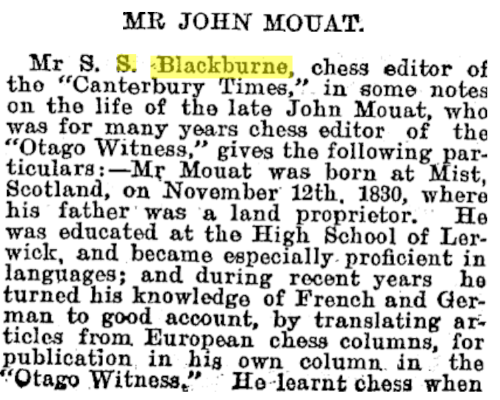
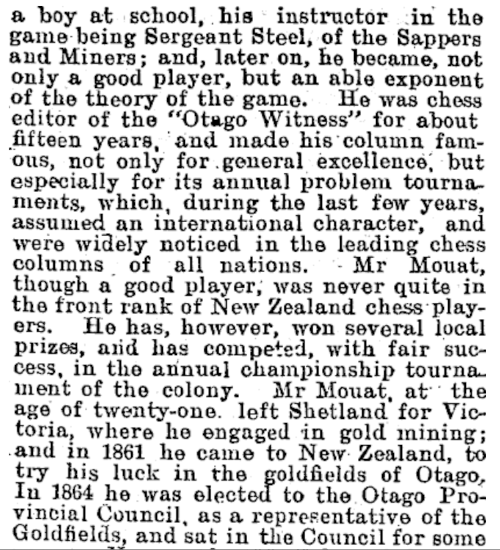
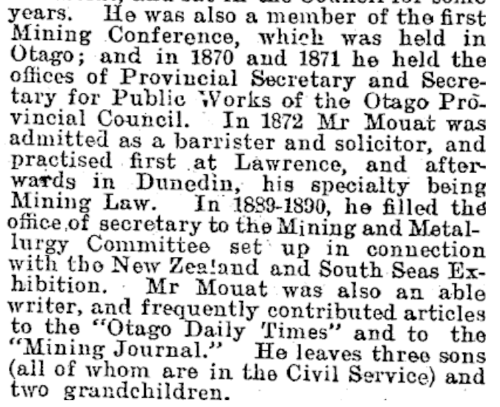
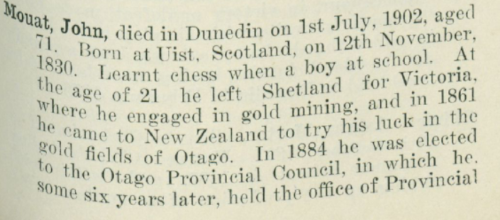
There passed away yesterday, after a prolonged illness, Mr John Mouat, whose name has for the last 40 years been widely and favourably known throughout Otago, and also wherever those who had been connected with gold mining in Otago were to be found. John Mouat, one of 10 children, was born at Unst, Scotland, on the 12th November, 1830, where his father was proprietor of a small estate (Brookpoint), which carried a number of crofter tenants. He received his education at the parish school of Unst, and at the High School of Lerwick, where he had as schoolmate the late Mr Basil Sievwright. Here he acquired a very competent knowledge of Greek and Latin, and sufficient French and German to enable him to read with facility works in these languages throughout his life. During his school days also he acquired a knowledge of chess from Sergeant Steel, of the Sappers and Miners, who was then in charge of a district of the Shetland Island for the Ordnance Survey. This knowledge he retained through life, and many an anxious and weary hour he beguiled over the board, his aptitude for the game, both in theory and practice, being very pronounced. At the ago of 21 he left Shetland for Victoria, being attracted, like many another, by the stories of fabulous wealth to be made in the newly-discovered goldfields of Australia. He arrived in Victoria on the 11th November, 1852, and engaged in gold mining. He was located at Simpson's Ranges, White Hills, in the Maryborough district, for some time, and met with the usual varying success of the gold-seeker. Here he made the acquaintance of Mr J. P. Armstrong. Subsequently he deeded to try his luck in Otago, and left Victoria, arriving in Dunedin on the 22nd December, 186I, setting out for the Tuapeka goldfields immediately thereafter. He had a claim at the Blue Spur and another at Wetherstones, both proving of a remunerative character. In 1864, he was elected to the Otago Provincial Council as member for the Goldfields, and sat as such representative almost continuously until 1873. On March 4, 1868, he was appointed a member of the first Mining Conference held in Otago. This commission was not up by the Provincial Government for the purpose of revising the goldfields regulations and drawing up new regulations suitable to the advanced condition of mining in the province. The other members of this conference were Vincent Pyke (chairman, John Lillie Gillies (both, with Mr Mouat, Provincial Council representatives), Michael Gaffney (representing St Bathans), William Carr (Tuapeka). James Hoyle (Mount Benger), Peter Limmond Lette (Switzers), Robert Swyer (Wakatipu), Colin Campbell M'lntyre (Clyde), and John Shannon (Hamiltons. The outcome of the labours of the conference was a new and amended code of regulations, published in the Provincial Gazette of April 22, 1665, which were generally conceded to be of an eminently practical character. On the resignation of the Otago Provincial Executive on May 6, 1869, the members then being Messrs Julius Vogel, Arthur John Burns, Bryan Cecil Haggitt, and John Hughes, a now Government was formed on May 10, 1869, the members of which were Messrs Donald Reid, George M'Lean, Bryan Cecil Haggitt, John Lillie Gillies, and John Mouat. Mr Mouat was for some time a member without portfolio, but afterwards filled the offices of Provincial Secretary and Secretary for Public Works. The Executive existed till April 3, 1871— somewhat longer than the usual term of office, the Provincial Governments of the early days lasting sometimes for a period less than a mouth and then resigned. Thereafter Mr Mouat turned his attention to the study of law, and he articled himself to the late Mr B. C. Haggitt, and subsequently, on 30th April, 1872, he was admitted to the New Zealand Bar as a barrister and solicitor by the late Mr Justice Chapman. He commenced practice at Lawrence, and was for some time in partnership with Mr W. H. M'Keay (at present Supreme Court librarian, the latter looking after the Dunedin branch of the business. Mr Mouat, however, after some years residence in Lawrence, returned to Dunedin, and practised on his own account until 1892, when he was joined in his law practice by his eldest son (the late Mr C. M. Mouat), whose early death in 1893 cut short a promising career, and no doubt was severely felt by his father. In 1889- 1890 Mr Mouat filled the office of secretary to the Mining and Metallurgy Committee set up in connection with the New Zealand and South Seas Exhibition. The other members were Messrs W. L. Simpson (chairman), Vincent Pyke, James Allen, M.H.R., John Mitchell. R. S. Sparrow, George M'Gavin, Professor Ulrich, James Hazlett, G. J. Binns, W. E. M’Adam, W. P. Watson, L. O. Beal, jun., and R. B. Denniston. Of Mr Mouat's forensic career it may be said that, in the zenith of his fame, his services as counsel in all mining cases of importance were eagerly sought. He was leading counsel in probably the longest jury case in the District Court at Lawrence- Clayton v. Morrison, which lasted for 27 days. Other causes celebre in which he was engaged may be mentioned the equity suits of Elliott v. Burke and others, Webb v. National Bank of New Zealand, and, more recently, the protracted action of Mills and others v. Isaac and others, which, we believe, has not yet ended. His special line, however, was mining law, and as an old digger he mad a deep study of everything in connection with this subject. As a consequence he was frequently engaged in writing leading articles for the Otago Daily Times on mining and kindred subjects. He was also on the staff of the Mining Journal when Mr R. L. Stanford (now magistrate at Palmerston North) filled the editorial chair. It may be mentioned here that Mr Mouat took an active, part in establishing the first newspaper in Lawrence the Tuapeka Recorder. He was also, while at Lawrence, secretary of the Railway League which eventually promoted the railway line from Dunedin to Lawrence, and was furthermore at one time employed by the Government, along with the late Messrs B. C. Haggitt and T. L. Shepherd, in drafting a Consolidated and Amended Mining Act. His one recreation was the game of chess, and for about 15 years he had been chess editor of the Otago Witness. Mr Mouat was a strong and enthusiastic, player, and frequently carried off prizes at the various tournaments held from time to time. Mr Mouat leaves three sons (all of whom are in the civil service) and two grandchildren. The only son resident in Dunedin is Mr F. J. Mouat, of the Lands and Survey Department
DEATH OF MR JOHN MOUAT. [3]
It is with extreme regret that we have to announce in this column the death of the former chess editor, Mr John Mouat, which occurred last Tuesday week some time after this portion of th« Witness had gone to press. The deceased gentleman had been ailing for some considerable time, suffering from weakness of the heart's action and general debility consequent on advanced years. His immediate relatives cherished a hope for some time that Mi Mouat's erstwhile Btiong constitution •wpuld eventually pull him through, but unfortunately their expectations in this respect were not realised, and "he passed away painlessly and peacefully on the evening of the Ist July at the age of 71 years. In the last issue of this paper, a full sketch of Mr Mouat's career was given, and in this column it is proposed only to deal with that part of his career relating to chess. It is sufficient for us to say that Mr Mouat learnt the principles of the game during his boyhood in the Shetland Islands from one Sergeant Steel, of the Sappers and .JKinexA. who was then in chaiee of a dve.txioi. of the Shetland Islands for the Ordnance Survey ; that from our own personal knowledge Mr Mouat took a considerable pride in his editorship of this column; and that during his gold-digging days in Victoria and Otago he beguiled away many an evening in friendlj contests with his tent mates. For the rest, we are indebted to the kindness of Mr R. A. Cleland, a club confrere, for the following remarks — " One of the pioneers of chess in New Zealand has passed away in the person of Mr John Mouat, editor of the chess column of the Otago Witness. For 40 years he- occupied a leading position, and was well known either personally or by reputation to every chess player in the colony. As he was as popular as he was well known his death will hs sincerely mourned by many friends 111 all parts. In the early days lie was probably the best player in Otago, and to the last he was an opponent who had to be reckoned with. He took part m six or seven of the meetings h"ld from time to time to determine the championship of New Zealand, and although he never gamed premier honours, he usually acquitted himself well, on one occa9.on carrying off the brilliancy prize. He had a profound knowledge of the openings and was a most dangerous player to meet. When in his best form he played a brilliant and dashing game, particularly if he had the attack He was, howeveT, most successful in telegraph matches — the environment seemed to suit him, and he icoicd victories over many n fcemflu his steel. For a player of his cbihty he was s-]ii£u!arly modest, and ho onr- could wish for a. more pleasant opponent. He was always courteous, genial and entertaining and entirely free from the petty failings of some chess players, who crow over a victory and excuse a defeat. He was once aptly described by a club mate as r ' chess tippler.' for he was always ready to play with anyone, and never appeared to get enongh. He delighted to play what are commonly called ' sk'ttle cniue3,' and it was no unnsua' experience fo.him to have from 10 to 15 games m an evening. On such occasions he was very amusing, for he always had some quaint sayings, often in Ger man, with which he punctuated his play. Af an editor, Mr Mcuat devoted much time to his column and spared no troable to make it attractive to his readers, translating items fron; the leading French. German and other Continental nnpers. His original articles were often written vi a racy style; sometime-, he hit lsnrd, but there was never, anything obiec-t-onable about his remarks, his one aim beui^ to advance chess. In the interests of his paner. ha nronioted several prob'eiu tourreys, open to the world, and received entries froi" snrh well-known comro -era ns Mockon-sie. P>-adig-nat," Je.=v>pr<>on. Charhrk. Glynn ;i"d othprs Af one of iho lurices in these ccmnctit.o i«, the writer can testify to their success. The d"ceised gfntlevnn has be»n herrd to exr>res<» the wish tr> have hii beloved o'"»ss in ihe life hereafter. Let us hope th°t if he i= d'a-uviointed in this, he has found something fir better "
At the usual Wednesday mectirsr o? the Otago Chess C!ub on th? 2nd lust. Mr J. Crow, vice-president, in the Jibscnoo of the president, feelingly refencd to thp loss sustained by the club by the death of Mr John Mouat. He said there had ju3t passed away, full of years, a gentleman to whom chess in Otago owed a great debt of gratitude, aud it was only right that thp m^mbeis of the Otago Ch«sa Club shruM h^\e an opportunity of coi veymg to the wido-.v ard faisi:i\ of the deceased gentleman Ihr!r nrroi. a..d 1' -en <-yaiuathy 111 their great beieavrmc it. Mr Mount, he said, might well be called the fathei of chess m Otago, for not only was he well known in this province as nn able plpyer aud exponent of the game, bvt ajso throughout tLo lc:.gth and breadth of Xcw Zealand and Auptiaha . n:deed, hi^ name wa- net u-iknown in chess circles in Europe, lor tiicv found r.^'racts f- 0111 the column >=o ab'y eJiled by h:ai 111 ih? Otago Witness published ia the cii2.~= colnniiis of Kuiopean papeis. 2>L~ Mouat had held ma.:y ]x,sitioirs 111 the cub, and was a mo?t valuable niembei. wlioae place it would be difficult to fill. During its v.ho'.e Instory he was an active member, aiid re h'ghly wero his services esteemed that the club. 111 recognition, unanimously rkcted him an honoiary life member. For jears he was a, regular visitor to the club's rooms, until overtaken by illne=s a low weeks back, and he was always willing and pleased to impart knowledge to beginners, and many players could now look back with pleasure to the days of their initiation into the mysteries of the game. He was a keen player, but a most generous onpoDeut, and chess could ill afford to lose such students of the game. The Revs. Canon King and Chodowski and Mr J Edwards 'ex-president) also spoke very f««*linglv of the worth and the esteem th?y fe!* for the deceased gentleman.
New Zealand Mail 23 July 1902
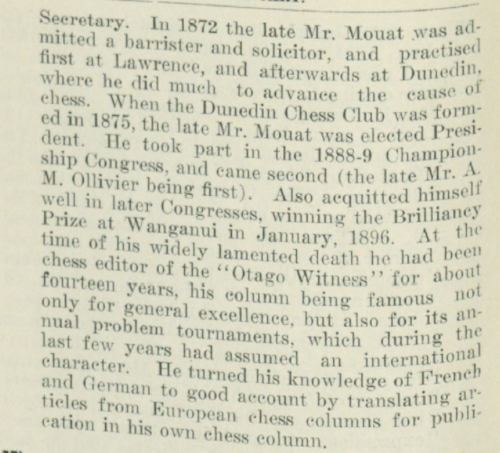
Book of the 30th & 31st Congresses
Obituary
NZ Chess Championships Results
--------------------------------------------------------------------------------------------------------------
References:
[1]
[2] Obituary - Otago Witness, 2 July 1902
[3] Otago Witness, 9 July 1902