Tame Eutahi Kirini (Thomas Eustace Green)
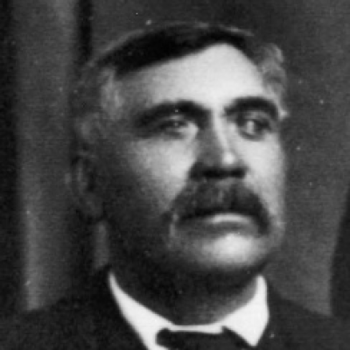
Thomas Eustace Green, One of Ngai Tahu's leading tohunga [2]
Thomas Green was born in 1840 and died in 1917. He is buried atTe Uruti, Tuahiwi. Green's political career reached its height when he was elected Upoko Runanga of Tuahiwi in the early 1900's.
Green was trained by the tohunga Natanahira Waruwarutu who had been previously trained by the Ngai Tu Ahuriri tohunga, Taiarorua. 1 Ngai Tahu was Green's iwi and Ngati Hinematua his hapu. Although Green could also claim descent from Ngati Mamoe and Waitaha he did not do so publicly. Green was taught within the Ngai Tahu school of genealogy (whare wananga) and his kawa held him to that school.
Te Aritaua Pitama, a later student of Green referred to Green as "... an Intellectual Giant in things concerning Maori genealogy and folklore."2 Te Aritaua recorded how Green and Waruwarutu learnt and it is clear that a very sharp mind was required as well as a liberal dosing of humility. Curiously enough, if one follows the inter-generational order of tohunga succession, the principle of holding senior whakapapa lines was not a major factor for entry into the whare wananga. Intellect and ability would appear to be the core requirements of access to the Whare Wananga.
Green represented the last batch of Ngai Tu Ahuriri tohunga trained in the formal system of the Ngai Tahu whare wananga. His
successor, Te Aritaua Pitama, was largely a keeper of tradition, rather than a fully fledged tohunga.
Green compiled numerous whakapapa books for his family and Ngai Tahu. His manuscripts were later used by Werita Tainui Te Ruapohatu Pitama (Stone Pitama) who established the core
genealogies for the Ngai Tahu Maori Trust Board in 1925. There are other notebooks of genealogies and several short traditions that Green recorded from his teacher Waruwarutu. All are fascinating and hold, in Ngai Tahu eyes, pure treasures of oral prose.
The largest manuscript written by Green and included in the family donation was from the tradition told to him by the Kaikoura tohunga, Tapiha Wanikau. The manuscript runs into 33 pages and was possibly written between 18501880. The manuscript is a detailed account of the Ngati Kurii migration from Te Whanganui a
Tara (Wellington) to Kaikoura.
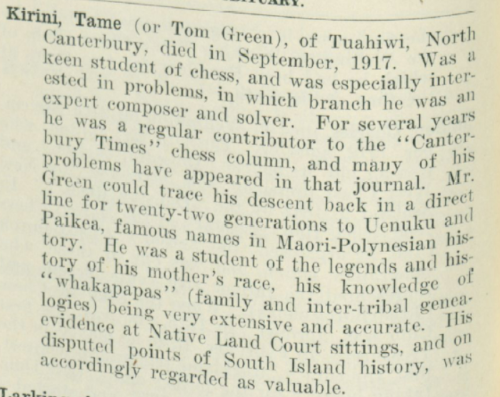
Obituary [3]
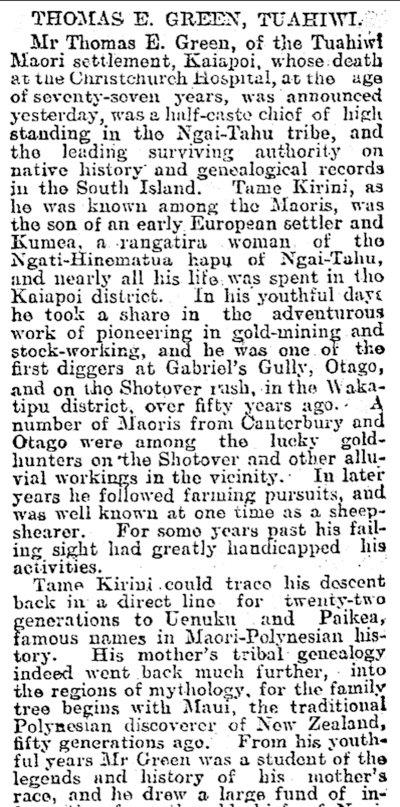
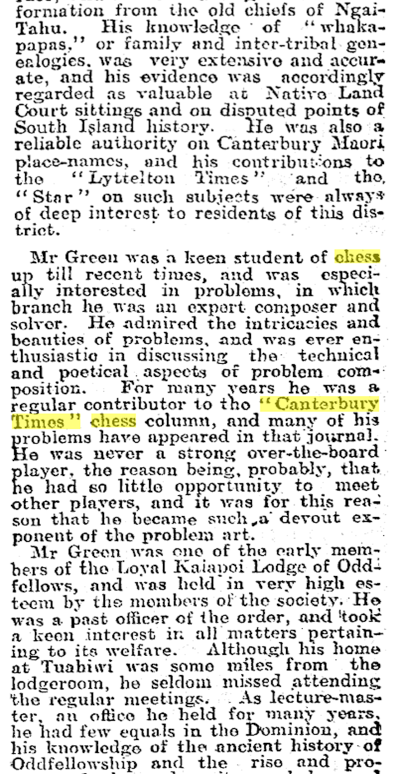
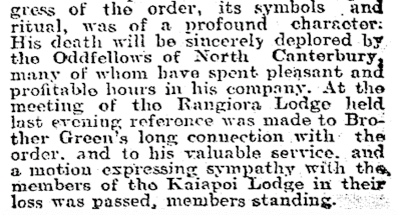
Book of the 30th & 31st Congresses
Obituary
-----------------------------------------------------------------------------------------------------------------------------------------------
References:
[1] Green, Thomas Eustace, 1840-1917. records/32002599
Alexander Turnbull Libray
[2] Te Karaka, The Ngai Tahu Magazine, Makariri/Winter 1996
[3] Obituary - Lyttelton Times, 4 September 1917